CS2 Pet Chicken Guide: How to Get One, Raise It, and Every Breed and Color
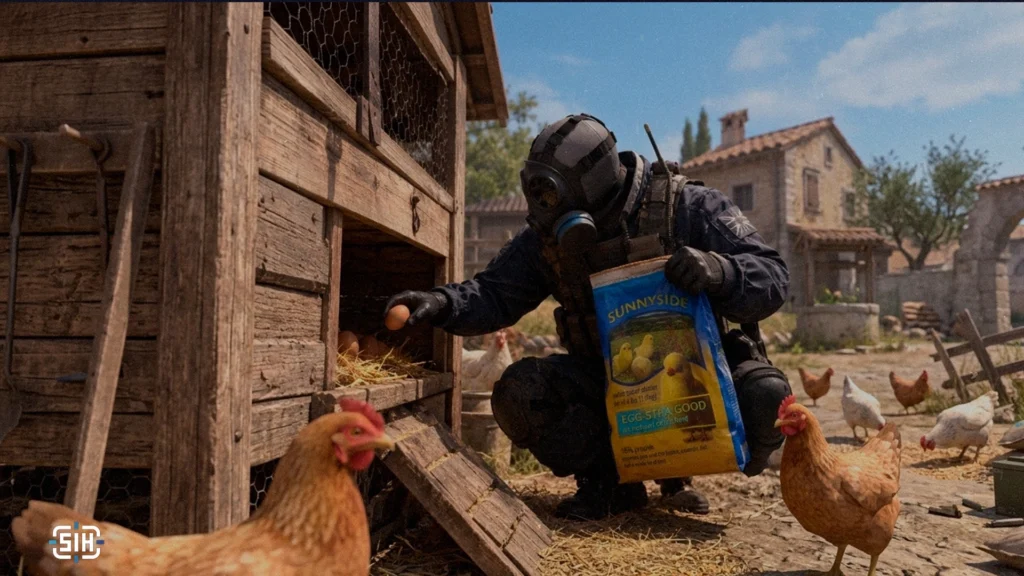
Valve’s Rush Hour update landed on September 22, and the patch notes had exactly one line about chickens: “they now take damage from the Zeus x27.” That was it. Not a word about the full-blown pet system shipped in the same patch — players found it on their own when their weekly drop offered a Chicken Egg where a case usually sits.
Chickens have been part of Counter-Strike longer than a lot of today’s players: they’ve wandered Italy and Inferno, given away positions with a well-timed cluck and soaked up more than their share of stray bullets. Dataminers had been spotting traces of pets in the game files since 2025, so for part of the community this felt less like a surprise and more like a release that was long overdue. What caught everyone off guard was the scope: growth stages, feed, three breeds, dozens of color variants, a photo booth and a scrapbook of its own.
In this guide, we’ve pulled together everything we know so far: what you can see in-game, what’s been found in the files and where the information still doesn’t line up. No eggs have hatched yet, so some of the mechanics are described from the game files alone.
How to Get a Chicken Egg
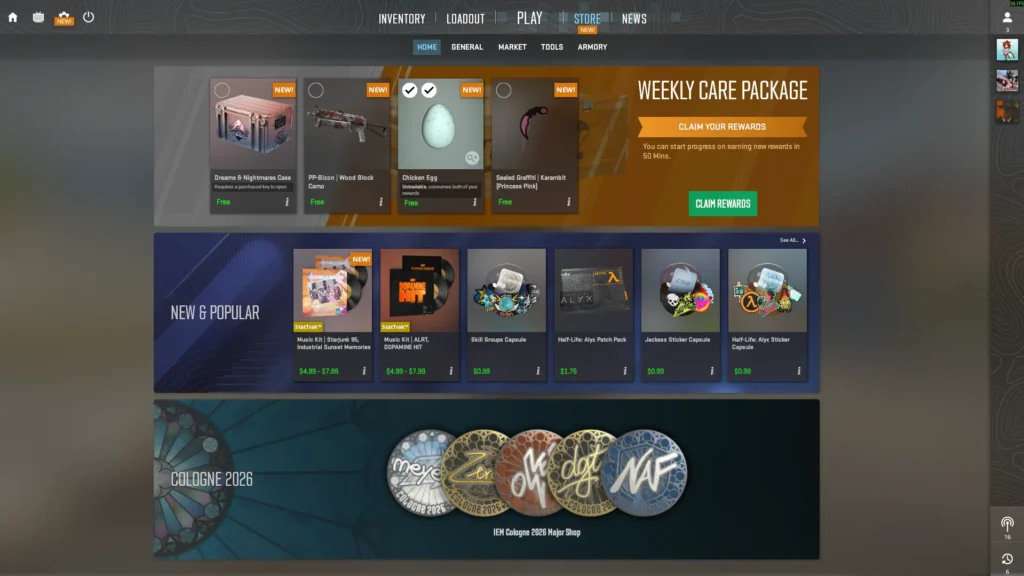
The only source is the Weekly Care Package, the reward for your first rank-up of the week. You’ll need Prime Status to get it. The package offers four items and normally lets you claim two, but the Chicken Egg takes up both slots: pick the egg, and you’re going without a case, skin or graffiti that week.
A few restrictions worth knowing up front:
- One pet per account. As long as you have a chicken or an egg, the game won’t offer you another one.
- No trading. The egg, the feed and the chicken itself are all flagged “cannot trade,” so you can’t transfer them or sell them on the Steam Community Market or third-party marketplaces.
- The egg isn’t in your Steam inventory. Once claimed, it sits in a wicker basket next to your agent in the main menu and takes up a new pet slot in your loadout.
You can inspect the egg just like a weapon: the camera cuts to a gloved hand holding it against the map backdrop. Friends in your lobby can see the basket too, which makes it the first cosmetic in CS2 that other players notice without opening your profile. The eggs themselves vary as well — reddish brown, cream, olive, mint and pale blue, with more or fewer speckles. Whether shell color has any bearing on the chicken you end up with is unknown. The files suggest it’s purely cosmetic, but we’ll find out soon enough.
One important detail: surprisingly, not everyone got an egg. Some players didn’t see one in their Weekly Care Package at all, so meeting their pet is on hold until next week at the earliest — maybe longer.
From Egg to Hen
The game has four stages, and each transition comes with its own message.
- Egg — sits in the basket for about a week. The hatch date is shown in the HatchBook. If the feed runs out, the egg won’t hatch.
- Pet Chick — every chick looks the same: yellow. You can name it, pet it, take photos with it and have it ride on your agent’s shoulder in the loadout screen.
- Pullet — its breed and color come in. From here on, you can take your chicken onto maps.
- Hen — fully grown. Photo booth poses that are off-limits to younger birds open up.
Hatching comes with an animation — the files contain two versions: the egg wobbles, cracks open and a chick climbs out. You can rename your pet once per stage with a free Name Tag, and the name shows up above it in-game as <owner>’s “<name>”.
From the Pullet stage, your chicken follows you into matches — but only if you’re the lobby host or queuing solo. Valve hasn’t said how long each stage lasts, and nobody has exact timers yet.
Feeding and Care
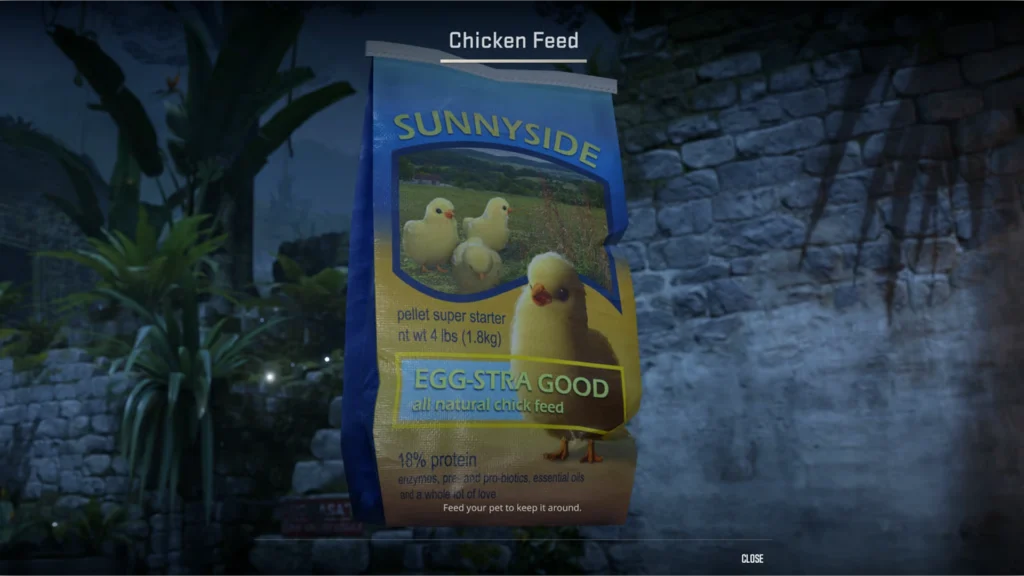
Your chicken will only grow if it has Chicken Feed — a blue bag from the fictional Sunnyside brand. Feed also comes from the Weekly Care Package, and it also takes up both slots. Once you have a pet, the rank-up tooltip reminds you to grab feed next time.
The system tracks how long your current supply will last against when the next growth stage is due. If the food would run out first, your pet gets flagged as needing feed, and a low-food warning shows up in its panel. Besides the standard bag, the files hold at least two more packaging models, a large bag and a bulk one; some sources describe them as separate feed for chicks and adult birds. How long a single bag lasts is still unknown.
If the feed does run out, your pet leaves for good. Valve handled this with its trademark dry humor: your chicken “has accepted a position elsewhere. The offer included meals.” An egg, meanwhile, “has been moved to a warmer nest.”
Breeds and Colors
Every chick grows into one of three breeds:
- Catalana — the classic CS chicken model, the same one that runs around the maps.
- Silkie — a fluffy breed, feathered all the way down to its feet.
- Polish — a slim bird with a big feathered crest.
Breed and color are locked in when your chick becomes a pullet, and there’s no way to influence the outcome. According to the files, the current pool has 34 colors: 13 for Catalana, 9 for Silkie and 12 for Polish. A few more colors are sitting in the files, but no chicken can grow into them yet — they’ll most likely be added later. That’s why you’ll see both 34 and 35 “skins” floating around in coverage. On top of that, every bird gets a slight random shift in shade.
Valve hasn’t published any odds. The percentages below are community estimates based on weights in the game files, calculated within each breed. The odds for the breed itself aren’t in the files.
- Catalana: the most common color is Tan (~21%); the rarest are Black with White Head, Light Blue and Red, Orange with Blue Neck, Yellow and Red, and Yellow-Red Gradient (~5% each).
- Silkie: the most common is White (~29%); the rarest are Leopard and Red (~14%).
- Polish: the most common is Pink (~30%); the rarest are Black with White Head, Brown with Black Wing Tips and White with Black Wing Tips (~10%).
Some colors have no weight in the files at all — Catalana Black, Silkie Purple and Polish Green, for example — which is why part of the community believes those are the real rarities. But that’s an assumption, not a confirmed mechanic. We’ll know more once the first chickens reach the Pullet stage.
Photo Booth and HatchBook
The most “game-like” part of the system is the photo booth. Once your egg hatches, you can pose your chicken with your CT or T agent and save the shots to the HatchBook — a scrapbook with separate chapters for the chick, the pullet and the hen. Since no eggs have hatched yet, the photo booth is still locked, and everything below comes from the game files.
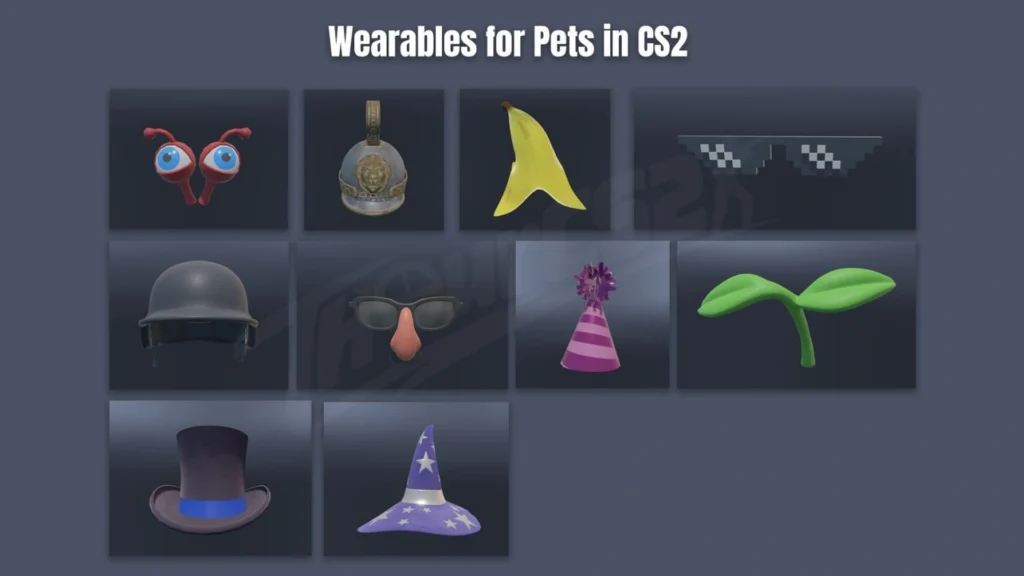
There are more than ten poses, from the classic shoulder perch to Bird in Hand and Protect. Some only unlock once your chicken is older, and a chick eventually outgrows others. Your chicken can wear one of ten hats: Wizard Hat, Top Hat, Party Hat, Banana, Sprout, Alien, Glasses, Nose Glasses, Helmet and Armor Helmet. On top of that, you get eight filters, effects like explosions, lightning, lasers and confetti, plus stickers from your inventory — and they aren’t used up when you place them on a photo.
Backdrops unlock gradually. Photo Studio and Picnic are available from the start, and Warehouse opens at the Pullet stage. Real map backdrops — Dust II, Mirage, Inferno, Nuke, Cache, Train and Ancient — unlock once you finish a match on that map on official servers with a pullet or hen in tow.
This is also where that lone Zeus line from the patch notes comes into play. Fire, lightning and explosion effects are normally reserved for hens, but they unlock early if your pet gets burned, zapped by a Zeus or caught in a C4 blast. Every incident like that is logged in the HatchBook on a Field Incident Report page.
Your chicken knows a few tricks, too: chicks spin in place, while grown birds flap their wings and take off, throw a karate kick and even play dead.
Your Chicken Won't Last Forever
Even with perfect care, your pet eventually moves on. In Valve’s words, a hen reaches “the end of a long, loud life” and leaves you. The HatchBook stays on your profile card, though, and you’re free to grab a new egg. How long the full cycle takes is still unknown.
Market Impact
There’s no direct impact, and there won’t be anytime soon: chickens, eggs and feed can’t be traded, so there’s no price to speak of. We doubt that changes in the near future. The pet is designed as a temporary companion that eventually leaves, and charging real money for something guaranteed to disappear would be a strange move for Valve. Marketplaces already promising you can “buy rare breeds” are getting ahead of themselves. Any offer to sell you an egg or a chicken right now is a scam.
The indirect effect is more interesting. The Weekly Care Package is a steady source of supply: it’s where cases from the active drop pool and skins from drop collections come from. Now real players have a reason to give up their drop on a regular basis — first for an egg, then for feed, which also eats both slots. Every week like that means one less case and one less skin hitting the market.
The effect on prices will be minor. Farms generate the bulk of weekly drops, and an untradable chicken is worthless to them — they’ll keep taking cases. The one-pet-per-account rule caps the effect even further. But over a span of months, the flow of items from drops will shrink slightly, and it’ll hit the cheapest drop-pool cases and skins hardest, since that’s where supply from real players makes up a noticeable share.
The second angle is where the system could go next. Hats, filters and backdrops are already in the files and, for now, unlock for free in-game. But the whole setup — a dedicated pet slot, accessories and a scrapbook — is easy to build on: new hats, accessory bundles or new kinds of pets could arrive as standalone items. Code for a hidden Armory offer that lets you get a Chicken Egg for stars has already turned up in the files. It isn’t active, but it shows Valve has at least considered monetizing pets through the Armory Pass.
Bottom line: pets are a rare case of Valve adding something to CS2 purely for fun, with no direct tie to the market. For traders, the value right now is indirect: slightly fewer drops reaching the market and groundwork for a possible new accessory category. If Valve follows the charms playbook and releases tradable hats or pet bundles, that becomes a full-fledged new niche — and we’ll be talking about chickens in very different numbers.
What We Still Don't Know
Valve hasn’t officially confirmed a single detail of the system. Still up in the air: how long the growth stages and the full life cycle last, how fast feed runs out, the actual odds for breeds and colors, when the unavailable colors will arrive and whether any animals besides chickens are on the way. We’ll be keeping a close eye on everything that happens with CS2’s chickens from here.

Alex
Alex is an author and esports observer with more than seven years of experience. He specializes in analyzing new releases in the world of computer games, gaming services, and in-game economies. Alex shares practical experience and an expert perspective on the development of gaming, helping readers understand complex mechanics and stay up to date with the latest news.

