Deadlock vs. CS2: Is the Hype Around Valve’s Record-Breaking New Game Justified?
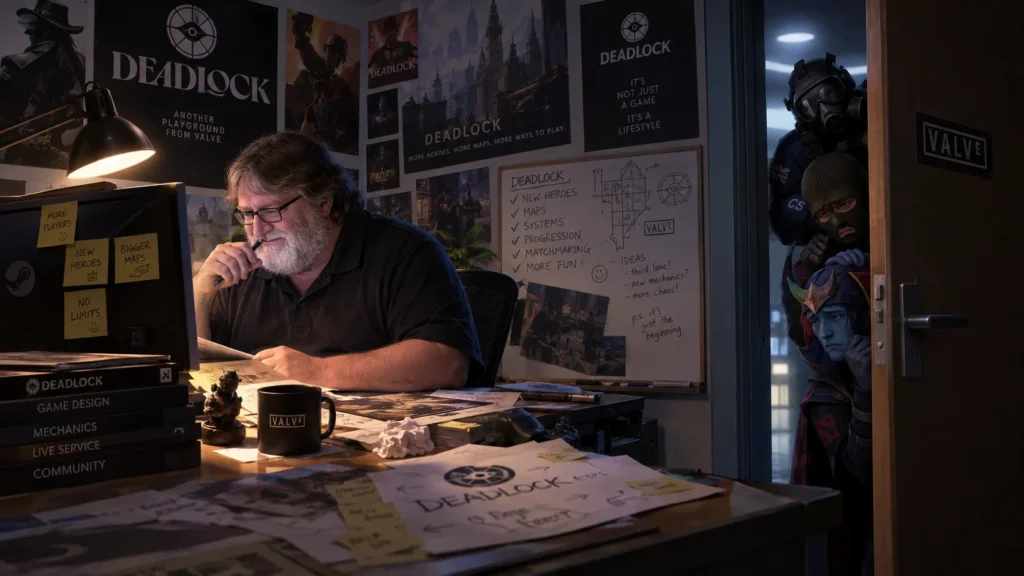
On Friday, October 16, Deadlock added a new hero — Violet, a painter. Fifty minutes later, 303,347 people were in the game. That’s a new all-time peak, and for a game still in closed beta, it’s a ridiculous number. A week earlier, Deadlock had already passed Team Fortress 2’s best-ever player count. Among Valve games, only CS2 and Dota 2 have higher peaks now. And this is a game that technically hasn’t even launched.
Counter-Strike has been heading the other way. In September, CS2’s average player count dropped for the seventh month in a row — a streak neither CS:GO nor CS2 had ever seen. No surprise, then, that every Deadlock patch thread says the same thing: Valve has moved everyone to the new game, CS is on life support, and the money will follow the players out the door.
If you hold a CS2 inventory, that stops being comment-section drama. It’s a question about what your skins will be worth once Deadlock gets its official release. So let’s break down where Deadlock’s records come from, where CS players are actually going, and whether any of it should keep you up at night.
How Many People Are Actually Playing
First, the thing that gets mixed up in almost every player-count argument: a peak and an average are two very different numbers. Deadlock’s record is one hour on a Friday night. CS2’s monthly average covers every hour of every day in the month.
So let’s compare averages. Over the last 30 days, Deadlock averaged about 111,000 concurrent players. CS2 averaged around 806,000 in September — its worst month in two and a half years. Dota 2 sat at roughly 571,000 that same month. And CS2’s all-time peak is 1,862,531 players, set not that long ago, in April 2025.
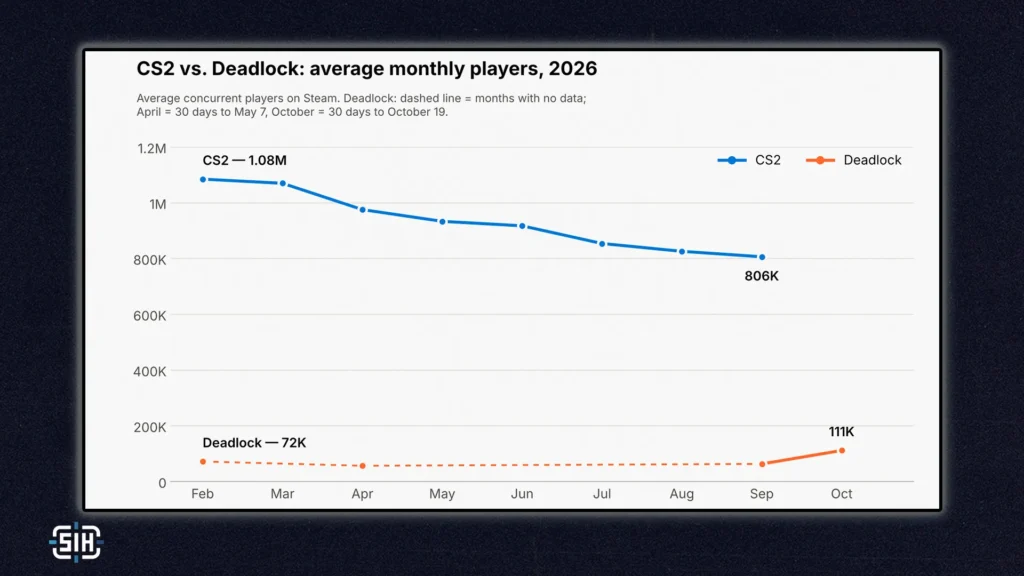
Put both games on the same chart and the drama disappears. CS2’s line starts at 1.08 million in February and drifts steadily down to 806,000 by September. Deadlock’s line hugs the bottom all year: around 72,000 in February, around 56,000 in the spring, around 63,000 in September. Only in October does it climb to 111,000. There are still roughly 700,000 players between the two.
The most interesting part of the chart is the timing. In February, both games were doing well at the same time: Deadlock was rolling out new heroes, and CS2 was having its best month of the year. Then CS2 spent six months losing players while Deadlock stayed flat. Deadlock’s surge didn’t come until October. If players were jumping from one game to the other, you’d see one line falling while the other rose. That never happened.
Where the Records Come From
On September 29, Deadlock got its big City Never Sleeps update: a reworked map, new monsters, a merchant called The Broker, and six new heroes. But the heroes didn’t all unlock at once. Valve released them two a week — Tuesdays and Fridays at 2 p.m. PT — in an order players chose by vote. And the only way to earn votes was to play matches.
A single day shows how it works. At noon UTC on October 16, Deadlock had about 101,000 players. By 7:30 p.m., it was up to 200,000 — standard evening prime time for Europe and the US. Violet dropped at 9 p.m., and within 50 minutes, another 100,000 people logged in. That’s your record: 303,347. By the next morning, 125,000 were left. According to deadlock-api, Deadman Danny and Violet showed up in almost every ranked match during their first hour — 98.7% of them. Everyone wants to try the new hero, and everyone shows up at the exact same moment to do it.
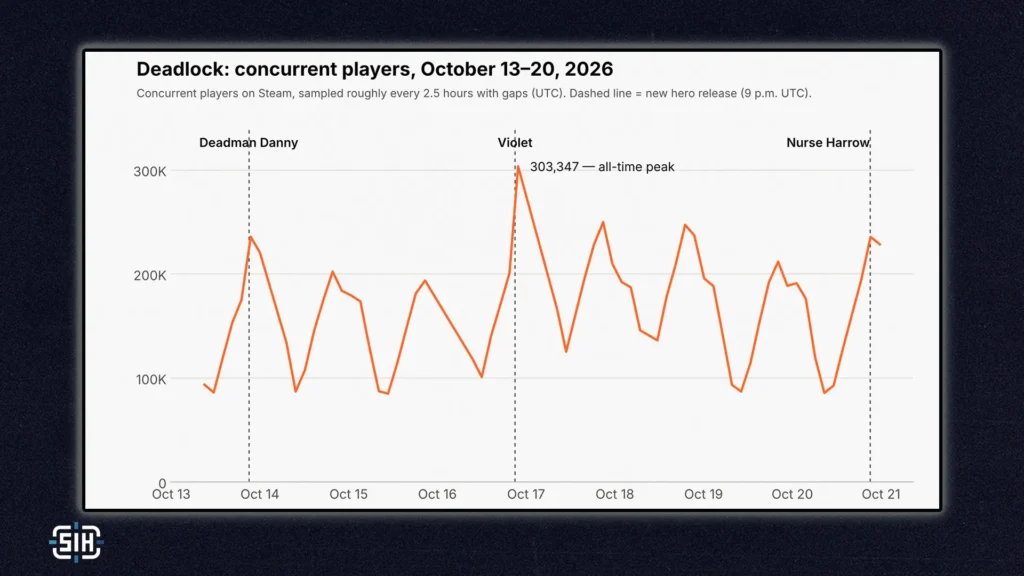
But the chart also shows something that never makes the headlines. On Saturday and Sunday, October 17 and 18, there were no new heroes, and evening player counts still held around 250,000. Meanwhile, Nurse Harrow, the last hero in the batch, pulled about 236,000 on October 20 — the same as Deadman Danny a week earlier, and less than a regular weekend. In other words, each new hero draws a little less, while interest in the game itself keeps growing.
The quiet hours tell the story even better. In September, Deadlock’s morning low dipped to 31,000–40,000 players. By mid-October, even the mornings sat around 85,000. That’s not a release-day spike anymore. That’s a regular player base that’s more than doubled.
Deadlock has been here before. Valve first tried staggered hero releases in August 2025, then repeated the approach in January and February 2026. Since then, the player count has moved in waves. In fall 2024, once people were allowed to talk about the game publicly, it hit 171,490 players. By summer 2025, the peak had fallen to around 16,000. New heroes pushed it back up to about 125,000 in February 2026, and by August it had slid to around 93,000. Every big update brings a spike, then interest fades. But each time, it fades a little less.
The last of the six heroes came out on October 20. There’s no scheduled reason to log in anymore, and the ranked season ends on November 5. November will show how many of those 85,000 are sticking around for good — and how many were just there to check out the new heroes.
Has Valve Abandoned Counter-Strike?
The idea that Valve forgot about CS for Deadlock isn’t new. In December 2024, Dota 2, Team Fortress 2, and even Deadlock got holiday updates. CS2 got nothing. The community didn’t take it well and drew some pretty gloomy conclusions.
But 2026 doesn’t fit that story. This year alone, CS2 got a reload overhaul, new animations with Animgraph 2, the return of Cache, a complete rework of bomb explosions, and plenty more. There was a nearly 10 GB patch in July, the new 3v3 Rush mode, regular Premier map pool updates, chicken pets, and a steady stream of smaller fixes. That’s not how you update an abandoned game. If anything, Valve is going after core mechanics it hadn’t touched in years.
Maybe that’s part of the answer. CS2’s player count has been falling since March — nobody’s disputing that. But Valve hasn’t walked away from the game: in 2026, it’s given CS2 more attention than it has in years. Which leads to a slightly ironic conclusion. CS players are a pretty conservative crowd, and nothing bothers them more than Valve messing with their “perfect world.” This year, Valve messed with it constantly: ammo, the bomb, animations, new modes.
We’ve seen this before. In 2023, people slammed CS2 for not being CS:GO. In April 2025, it set an all-time record of 1,862,531 players. Give it time, and today’s changes will become the new “perfect CS” — the one that breaks the next player record.
What This Means for Your Inventory
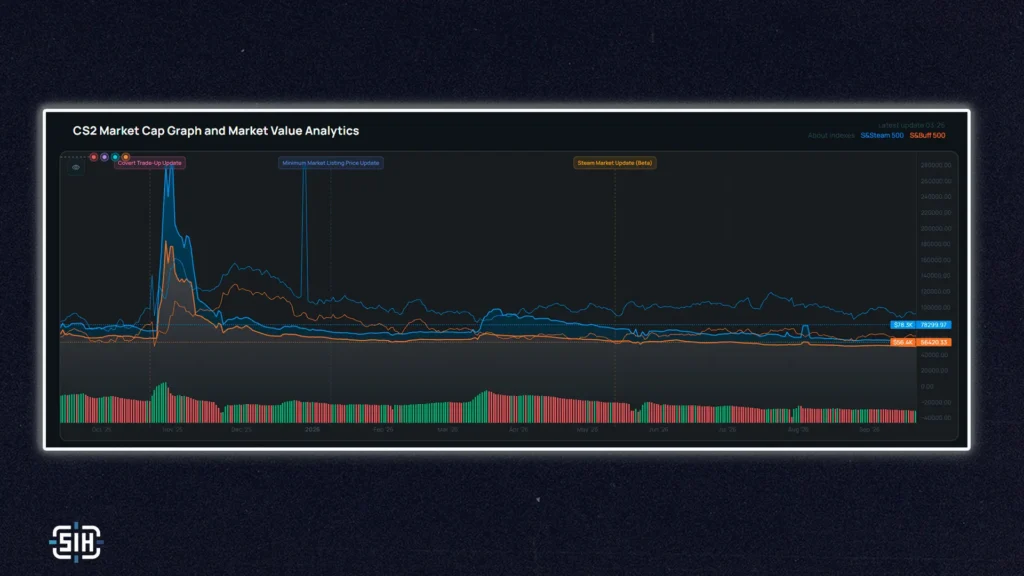
For traders, the real question is simple: could money from the CS2 skin market flow into Deadlock? The short answer is not anytime soon. And it’s not just about player counts.
CS2 skins aren’t valuable just because they look good. The item ecosystem in CS is so deep that building anything comparable would take serious work. There’s float and patterns. There’s rarity tied to specific cases and collections. There are Major stickers that link the market to esports. There are trade-up contracts. And all of it has been built up since August 2013, when The Arms Deal update came out.
If skin owners should be worried about anything, it’s not Deadlock — it’s Valve’s own decisions inside CS2. The best example happened exactly a year ago. Valve let players craft knives and gloves through trade-ups, and within days, the market dropped from about $6 billion to $3.5 billion. Regular knives without rare patterns still trade 40–55% below where they were before. No rival game has ever hit the skin market the way a single Valve patch did.
Deadlock will get skins, of course. Valve has already said it’s working on hero customization and wants to polish it before the full release. Our guess is that the game leaving beta and the store opening will happen around the same time, though Valve itself hasn’t said so. The first items will probably fly off the shelves, and some traders will try to cash in on the new market from day one — that happens with any new collection.
But in Deadlock, a skin goes on a hero, not on the weapon you’re holding every single round. That’s closer to Dota 2, where cosmetics have been bought, sold, and traded for years, but an investment market on the scale of CS never took shape. Whether Deadlock skins get float, patterns, and all the other details depends entirely on whether Valve wants to copy the CS model. So far, there’s been no word on that. You can build a store in one patch. The trust the CS market has been running on for thirteen years — not so much.
The Genre Has a Ceiling
Technically, Deadlock is a closed test, and its Steam page still says “To be announced.” But getting in is easy: any player can invite friends, and invites get handed out to anyone who asks on Reddit and Discord. So “still in beta” explains why the player count swings from patch to patch, but it’s not what’s keeping new players away. The game itself is.
Deadlock is a MOBA and a third-person shooter at the same time. Lanes, creeps, souls, items, abilities — and on top of all that, you still have to aim and actually hit your shots. That’s harder to learn than either genre on its own. Since the early months, newcomers on the Steam forums have been complaining that after a dozen matches, they get thrown into lobbies with experienced players and turn into target practice.
Dota 2 is the clearest example of how this plays out. Its player count is doing just fine: in August 2026, during The International in Shanghai, Dota had its best month since October 2016, averaging 617,000 players. But for a decade now, it hasn’t broken past a certain level. In 2026, its monthly average swung between 423,000 in May and 617,000 in August, depending on patches, events, and tournaments. Even in its best years, Dota never reached CS numbers. Complex games can build huge, loyal audiences, but they don’t go mainstream the way Counter-Strike does. In CS, everything clicks in the first round: you load in, buy an AK-47, and play.
Deadlock isn’t simpler than Dota — in a lot of ways, it’s harder. So the realistic expectation isn’t a “CS2 killer,” but a second big MOBA for Valve — with a large audience of its own and some competition with Dota 2.
SIH's Take
The hype around Deadlock is justified — just not the hype in the headlines. Valve built the 300,000 record on a clear formula: a big update, two heroes a week, and a vote you have to play to take part in. But the regular player base doubling? That’s starting to look like real growth. Valve really is getting a third big game. It’s just growing alongside Counter-Strike, not at its expense.
CS2’s problems are inside CS2. And so are the risks to your inventory. In November, once the new heroes and the ranked season wrap up, we’ll come back to these charts and see whether those players stick with Deadlock — and what happens to CS2 in the meantime.

Alex
Alex is an author and esports observer with more than seven years of experience. He specializes in analyzing new releases in the world of computer games, gaming services, and in-game economies. Alex shares practical experience and an expert perspective on the development of gaming, helping readers understand complex mechanics and stay up to date with the latest news.

